The Ponds

When I arrived here, there was no water feature.
The nearest pond is down the hill and across the road where the little river Fieffes (more of a stream really) runs through it.
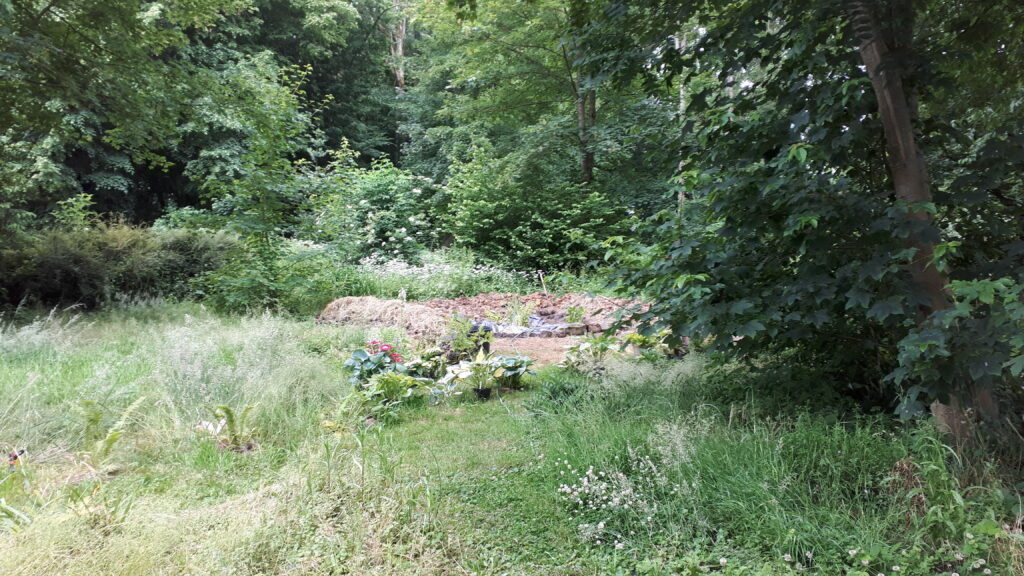
Up on the ‘plateau’, a small clearing before the woods, the subsoil is a soft clay with no stones and Nixon, the Golden Retriever, was enjoying digging a very big hole.
From there, I decided it would be a great place for a wildlife pond, and so the ‘first pond’ was born.
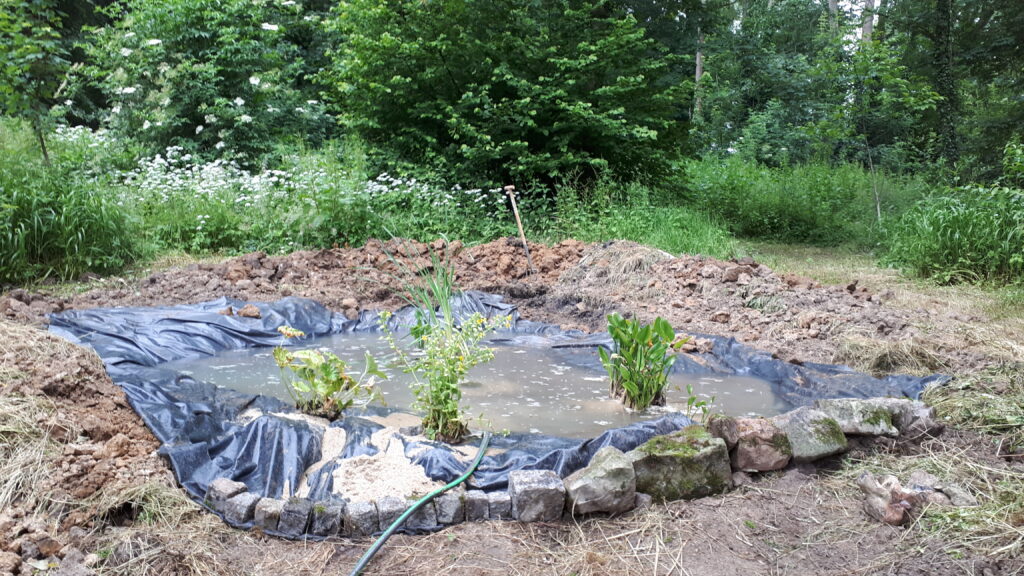
It took me just one afternoon and evening to dig, line, and fill it,
and because of a small hole in the middle of the liner (delivery damage, in fact), it had a curious ‘figure-of-eight’ shape.

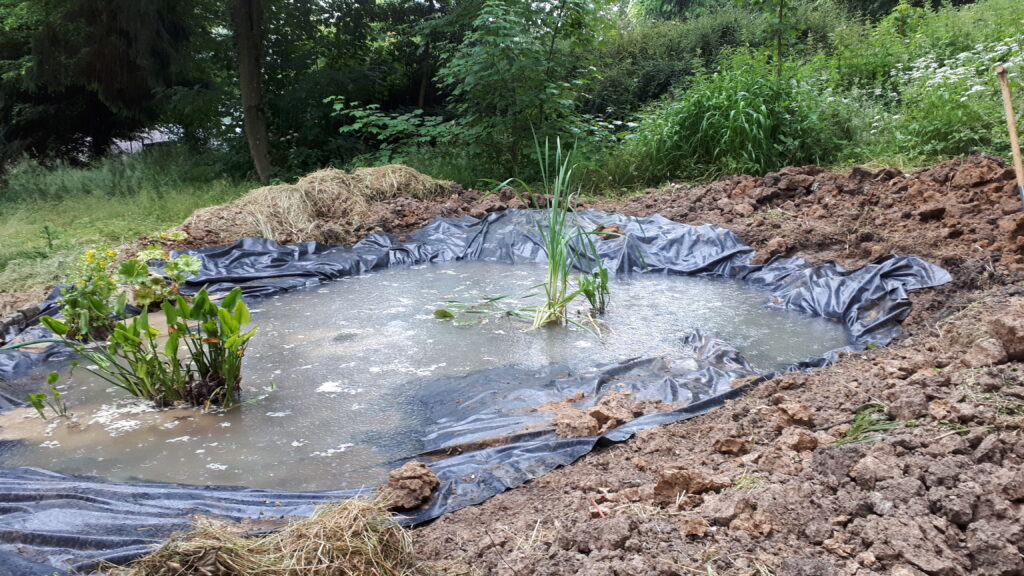
The following year, using the replacement liner sent by the supplier for the delivery damage, I was able to build a second pond, slightly downhill of the first, and this time bigger and deeper. The edge of the pond came to my shoulder-height when I was standing at the deepest point.

At the end of May 2026, the ‘second pond’ was teeming with tadpoles.
Newts or frogs?
…Too early to say just yet.

One thing for certain is that this is a ‘newt pond’, as I’ve seen a few of those tell-tale ‘figure-of-eight’ tail turns just under the surface.
Seeing a newt-like form at the bottom of the pond while pulling nettles from around the sides, I decided to take a few photos.
Just at the moment I thought I’d try to film a short video, the newt in question popped up to say « hello! »

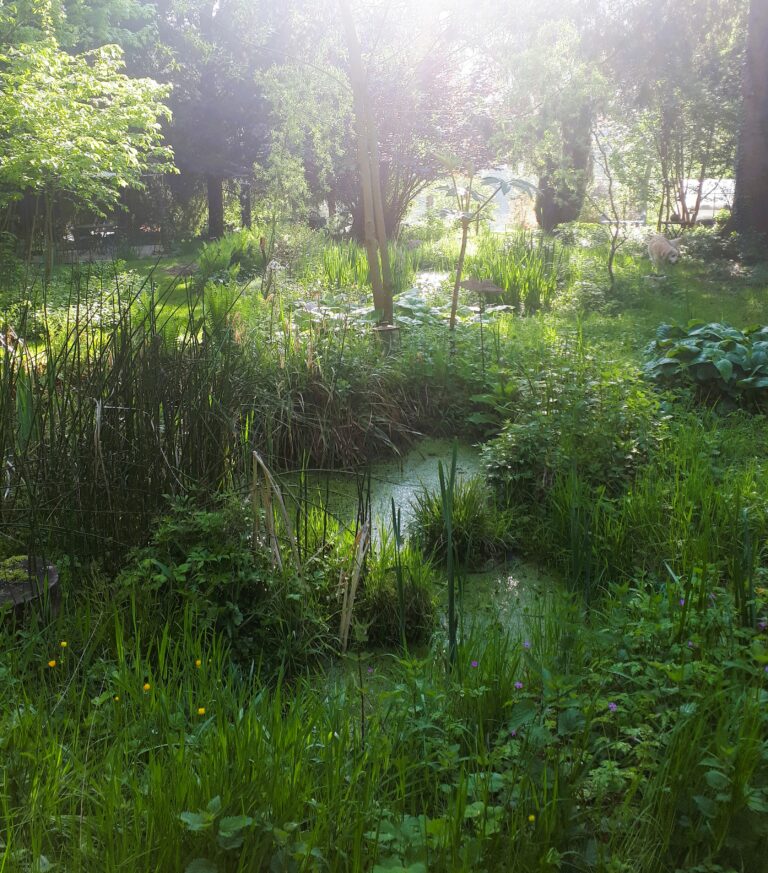
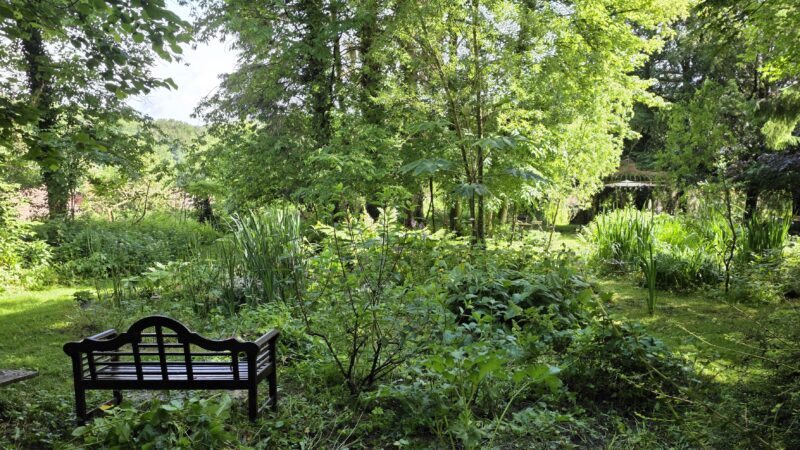
From the ‘Lutyens bench’, there’s a view down the slope, across the two ponds to the arbour.

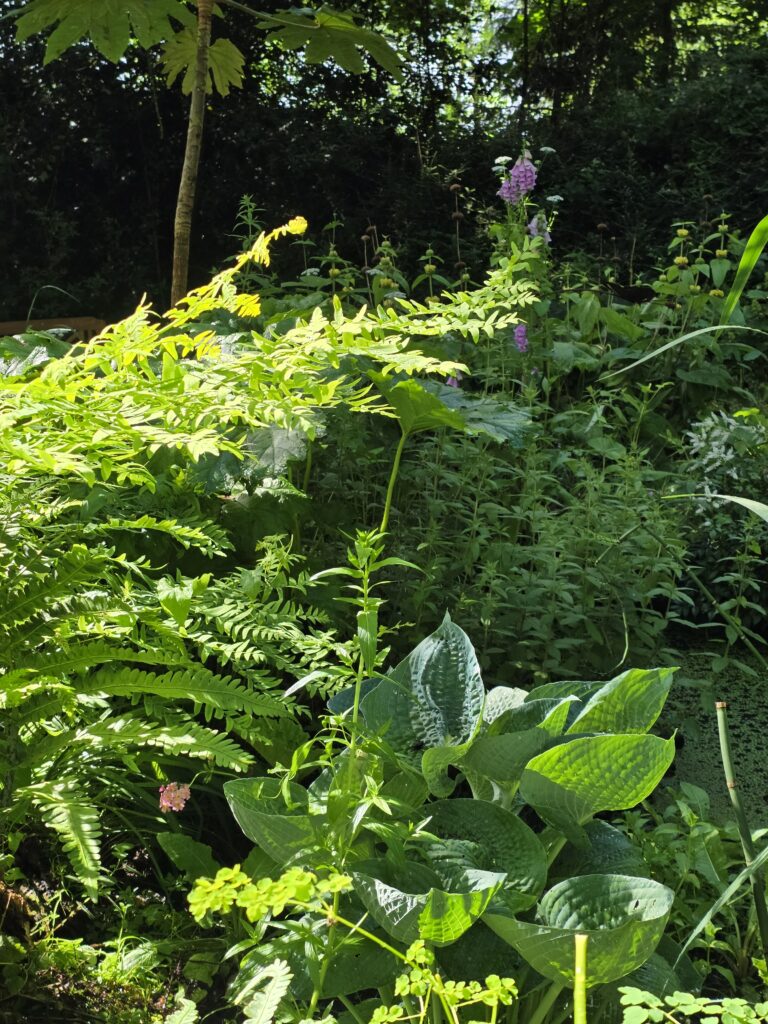
Both ponds are surrounded by a rich undergrowth of ferns, hostas, Rogersii sp., Thalictrums, Geums, and water iris (Iris pseudacorus),
as well as a host of other perennials.

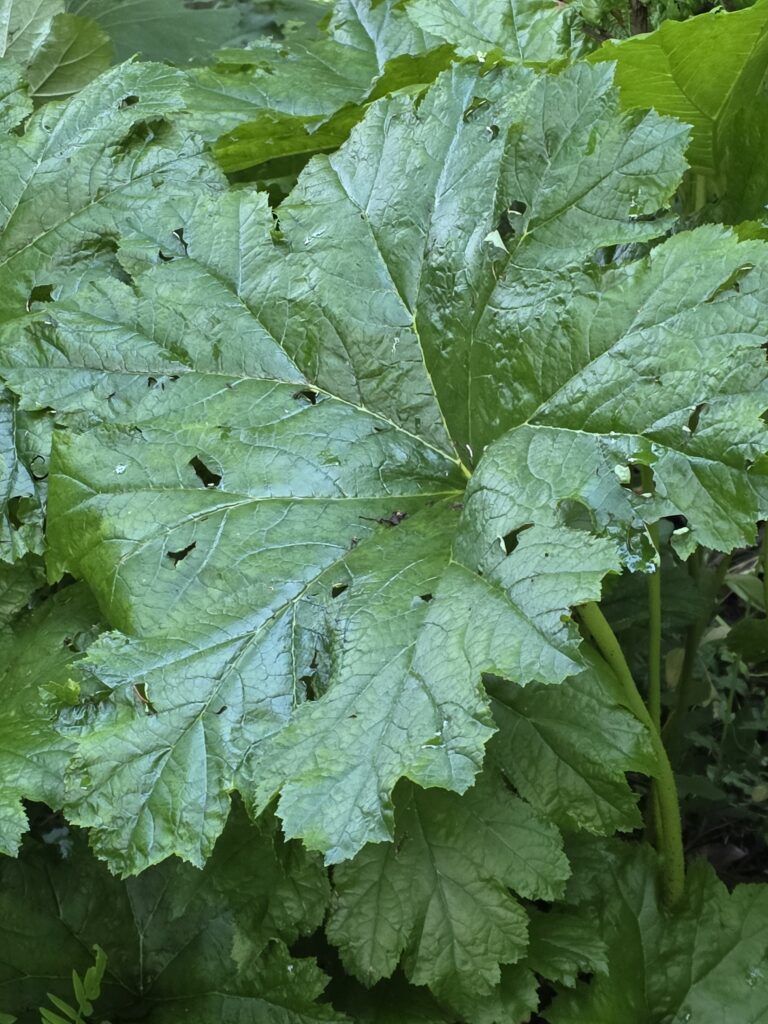
The majestic fronds of the ‘Royal fern’, (Osmunda regalis), the horizontal leaves of the ‘umbrella plant’ (Darmera peltata), and Hosta Abiqua Drinking Gourd, along with several Thalictrum sp., provide a lush green cover for amphibians and insects in the first pond, with its ‘bog garden’.
In the foreground a salmon-pink flower of Primula bulleyana (the ‘candelabra primula’) echoes a pinkish purple foxglove (Digitalis purpurea) on the far side, in front of the stout stems of Phlomis russeliana with its whorls of hooded soft yellow flowers.
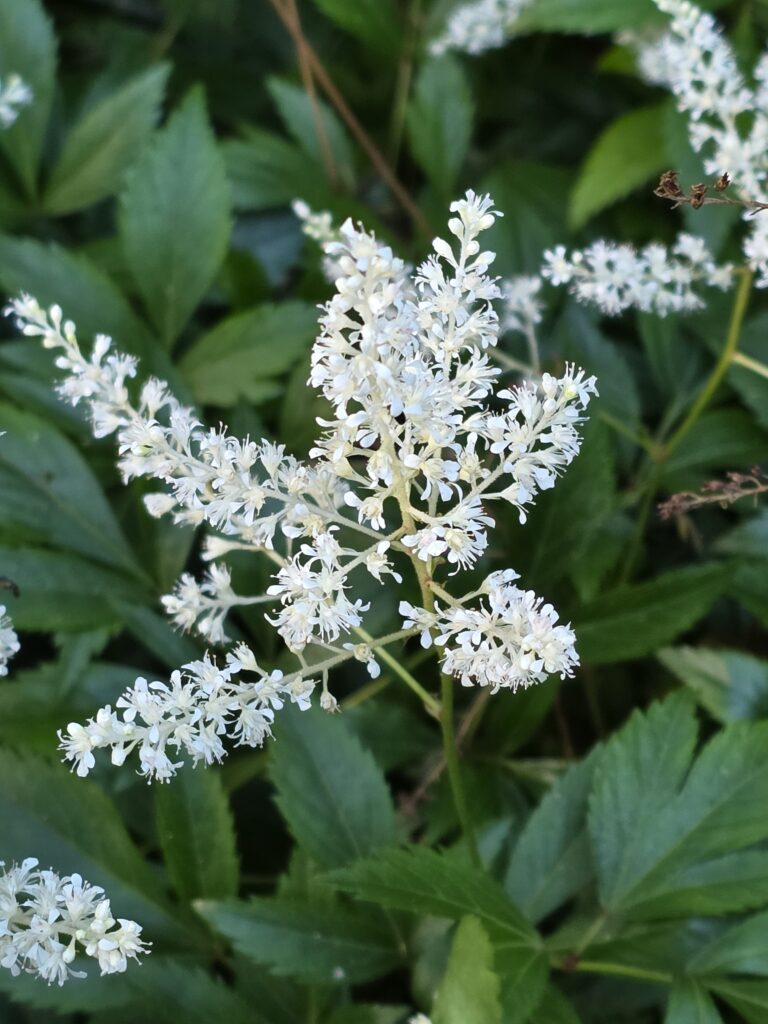
White Astilbe japonica and yellow Loosestrife (Lysimachia vulgaris), along with Creeping Jenny (Lysimachia nummularia aurea) are all features of this ‘first pond’.

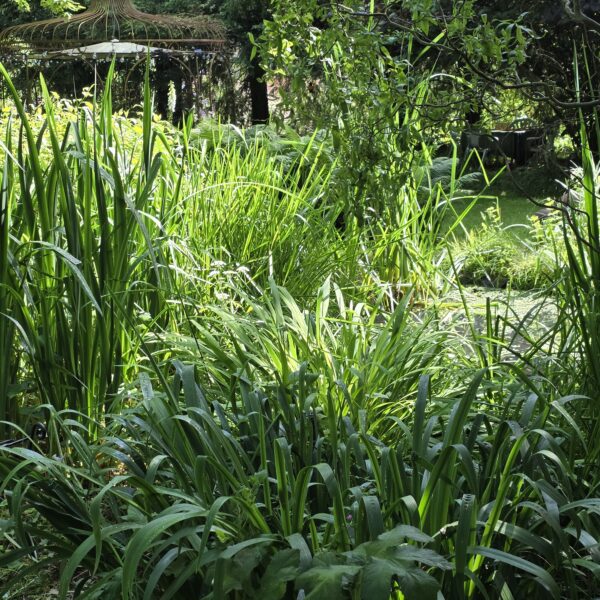
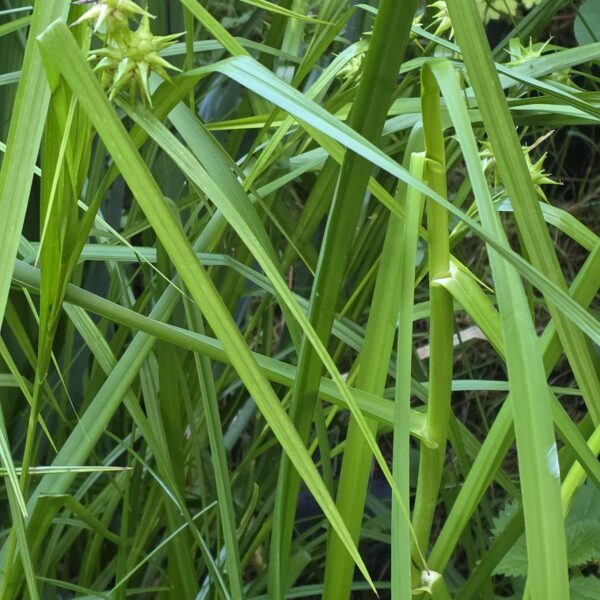
The second pond has a quite different marginal flora, again with the ubiquitous yellow flag iris (Iris pseudacorus), but a host of other vertical leaves, including – in the foreground – Crocosmia Red Lucifer (scarlet red Montbretia) and the Virginia iris (Iris virginica), along with Sweet flag (Acorus Calamus), Gray’s sedge (Carex grayi), and the classic bulrush, Typha sp.
The twisted stems of two twisted willows (Salix babylonica tortuosa) overhang the upper ‘entrance’ to this pond.

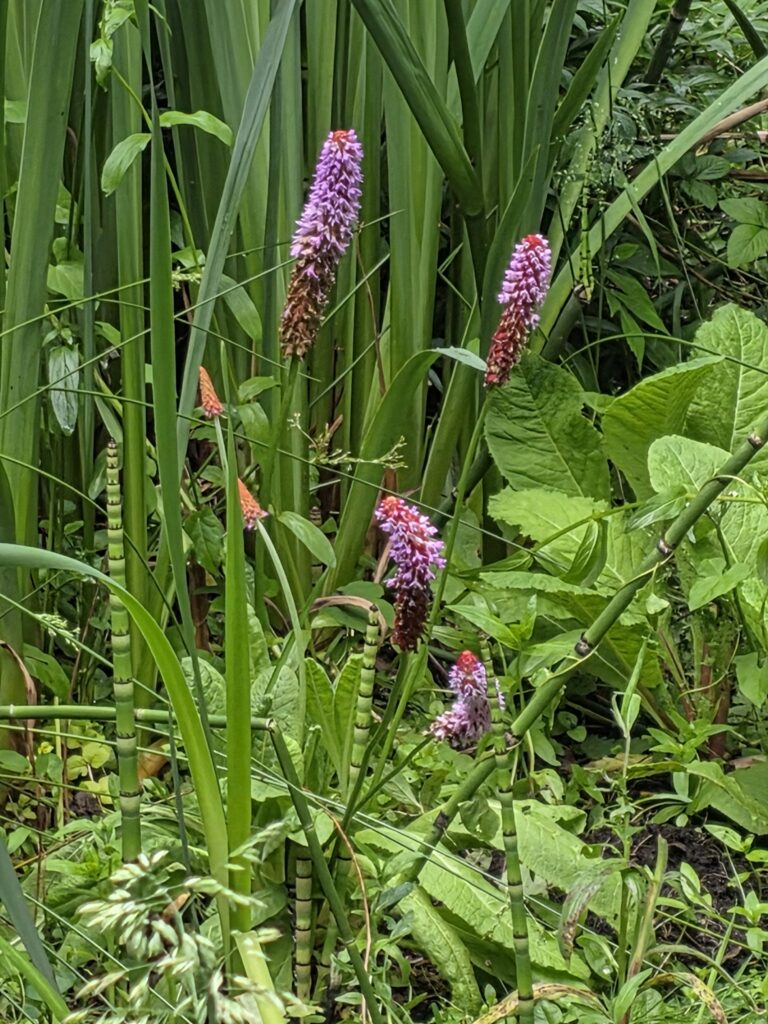
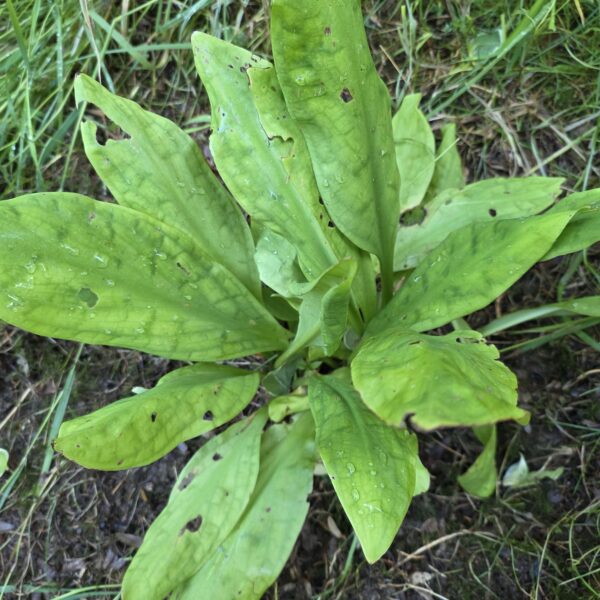
Primula vialii lives in wet meadows or near water in the high valleys of SW Sichuan and northern Yunnan in southern China.

Astilbe japonica, or ‘False buck’s beard’, is – as its name implies – native to Japan.

Darmera peltata, the ‘Indian rhubarb’ or ‘umbrella plant’, has bunches of pink flowers atop a flower spike that appears in early spring, before the leaves.

Gray’s sedge (Carex grayi) is easily recognisable with its seed heads that look like spiked clubs from some medieval knight’s weaponry!

The ‘American skunk cabbage’ (Lysichiton americanus) has magnificent yellow arum-like flowers that give off a pungent smell (hence its name!) in the early season. This one is under strict surveillance, as this species is now classified amongst the ‘invasive species’ in Europe.

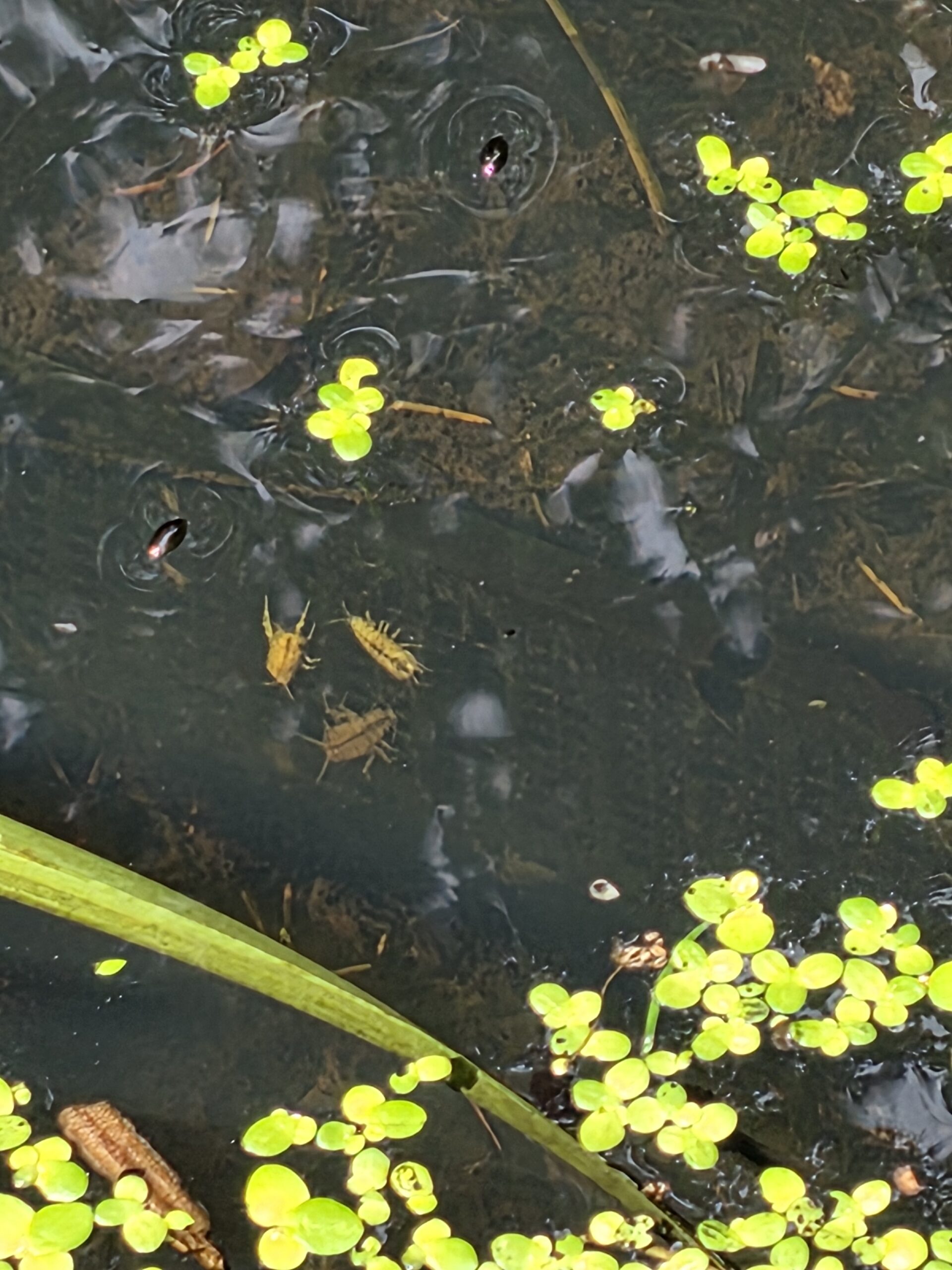
Here, you can easily make out the three Water Slaters – or Water Hog-lice – Asellus aquaticus who have congregated on a ledge in the pond.
They generally like to eat organic material on the bottom and don’t swim very well or very far.
Just on the surface, you can see two ‘Whirligig’ beetles (Gyrinus substriatus), so named because of the way they spin in circles on the water.
The adult beetles are able to float on top of the water as they can store air in a dorsal reservoir for buoyancy, and they have a water repellent body surface and a set of bristles around the head and antenna, which all help to keep the beetle above the water. 
They’re also able to go below the surface as long as they are rapidly swimming or hanging on to some underwater vegetation. 
Whirligig beetles are able to stay underwater for extended periods of time because of their dorsal reservoir which allows them to store air. 
Because they swim both above and below the water’s surface, they have compound eyes which are like two pairs of eyes: one to see below the surface of the water and one to see above it.